

The default advice in the WooCommerce community is “use Stripe.” It’s fast to set up, well-documented, has an official WooCommerce plugin, and the developer experience is genuinely excellent. For most stores, it’s the right call.
But when you’re selling digital products — plugins, themes, software licenses, online courses — to customers in the EU, UK, Australia, or Canada, “just use Stripe” glosses over a compliance problem that can turn into a very expensive mistake. This comparison breaks down where Stripe and Paddle actually differ, what each costs in practice, and how to decide which one belongs in your WooCommerce setup.
They’re Not Competing for the Same Job
Before comparing features, it’s worth clarifying something that most comparison guides skip entirely.
Stripe is a payment processor. It moves money from your customer’s card to your account. Full stop. Everything around that transaction — tax calculation, tax collection, tax remittance, compliance — is your responsibility.
Paddle is a Merchant of Record (MoR). When a customer buys through Paddle, they’re legally purchasing from Paddle, not from you. Paddle is the seller on the receipt. They handle the money movement, but they also collect and remit VAT in the EU, GST in Australia, consumption tax in Japan, and sales tax across US states that require it. They file the returns. They deal with the tax authorities. You get a payout.
That legal distinction changes everything else in this comparison.
The Tax Problem Nobody Wants to Think About
If you sell software or digital products to EU customers, you’re required to charge VAT at the customer’s local rate and remit it to their country’s tax authority. Since 2021, the EU’s VAT One-Stop Shop (OSS) scheme has simplified the paperwork — instead of registering in each country separately, you can file a single quarterly return through your home country’s tax office.
“Simplified” is doing a lot of work in that sentence. You still need to register for VAT OSS, collect proof data to establish where each customer is located (IP address, billing address, and payment country — not just one of them), file four returns per year, and pay the tax in euros even if you invoice in USD. Miss a quarter and the penalties stack up fast.
With Stripe, you handle all of this yourself. Stripe Tax ($0.50 per taxable transaction, after the first 500/month) automates calculation and collection at checkout. The filings and remittance are still your problem. For a developer spending 5–8 hours per quarter on compliance, that’s $500–1,000/year in time cost before any accounting fees.
With Paddle, it’s not your problem. They’re registered everywhere they need to be. They calculate, collect, and remit automatically. You don’t file anything. Plugin developers I’ve talked to switched to Paddle entirely after their first year of manual EU VAT filing — not because of the checkout experience or the feature set, but simply because they didn’t want to think about it anymore.
If your customers are primarily in the US and you’re not dealing with digital goods taxes, this section is largely irrelevant. If they’re international, it’s probably the deciding factor in this entire comparison.
Fees: The Numbers Most Posts Get Wrong
Standard fees at a glance:
| Stripe | Paddle | |
|---|---|---|
| Base fee | 2.9% + $0.30 | 5.0% + $0.50 |
| International card surcharge | +1.5% | Included |
| Currency conversion | +1.5% | Included |
| Tax calculation & collection | Stripe Tax (separate cost) | Included |
| Tax filing & remittance | Your responsibility | Paddle’s responsibility |
On a $49 transaction with a US card:
- Stripe: $49 × 2.9% + $0.30 = $1.72 fee, you net $47.28
- Paddle: $49 × 5.0% + $0.50 = $2.95 fee, you net $46.05
That’s $1.23 more per sale with Paddle. On 100 sales at $49, Paddle costs you $123 more per month than Stripe’s headline rate.
Now look at a realistic international scenario. Your EU customer pays with a German card in euros. Stripe’s effective rate: 2.9% + 1.5% (international card) + 1.5% (currency conversion) = 5.9% + $0.30. That’s already more expensive than Paddle before you add Stripe Tax or any compliance overhead. The gap between the two narrows substantially once you move off US-card-only assumptions.
The math genuinely favors Stripe for low-ticket items with domestic US customers. For anything above $30–40 with international exposure, Paddle becomes competitive once total compliance cost is factored in.
WooCommerce Integration: Reality vs. Marketing
This is where Paddle has a clear, honest weakness.
Stripe has an official WooCommerce plugin maintained by Automattic. It supports cards, Apple Pay, Google Pay, SEPA Direct Debit, iDEAL, Bancontact, and more. Setup takes about 20 minutes. It handles 3D Secure automatically, works cleanly with WooCommerce Subscriptions, and gets updated on a regular schedule. For the vast majority of WooCommerce stores, this integration is about as solid as it gets.
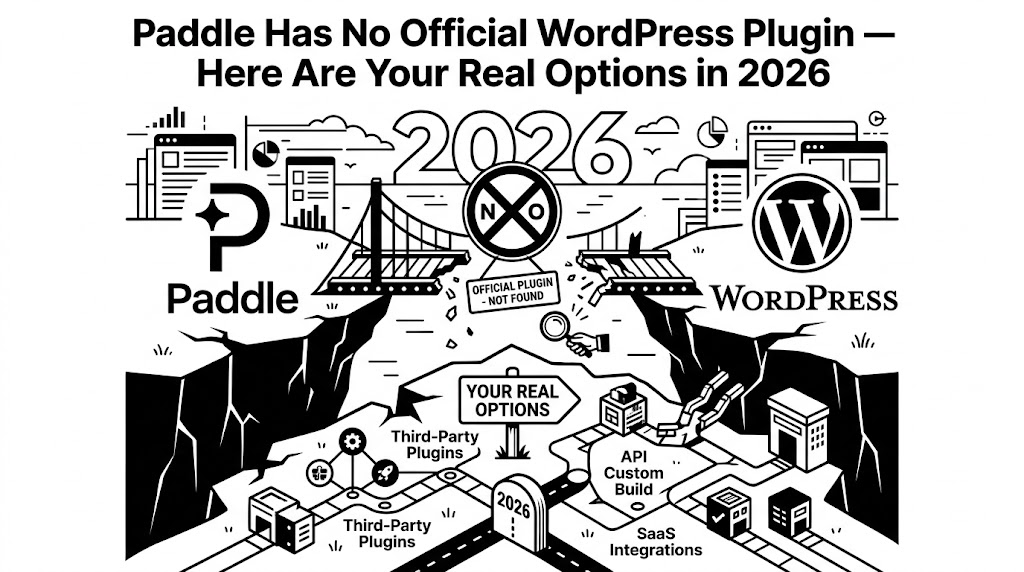
Paddle has no official WooCommerce plugin. We’ve covered the full landscape of what’s available — the short version is that third-party options exist, quality varies significantly, and several of the free GitHub options haven’t been updated since Paddle launched their current Billing API in 2023. The plugin that worked with Paddle Classic (their old product) often doesn’t work correctly with Paddle Billing, and the distinction isn’t always clearly documented.
If you’re building a WooCommerce store on Paddle, the integration layer deserves careful evaluation before you commit. Look specifically for a plugin that handles Paddle’s webhook-based order fulfillment correctly — Paddle doesn’t redirect customers back to WooCommerce after payment the same way Stripe does, and plugins that don’t account for this will leave you with orders stuck in “pending” indefinitely.
Our Paddle Billing Gateway for WooCommerce was built specifically around the current Billing API and handles the webhook flow, subscription management, and order status transitions correctly. But the broader point stands: Stripe’s WooCommerce integration is more mature, and that matters if you’re not prepared to evaluate plugin quality carefully.
Checkout Experience and Customization
Stripe gives you three options. Stripe Elements embeds a fully customizable checkout directly on your site — customers never leave your domain, and you control every pixel. Stripe Checkout is a hosted page with less customization but faster to set up. Payment Links are no-code, for simple use cases. With Elements, your checkout looks like part of your site. Stripe branding is optional.
Paddle’s default checkout is an overlay modal that appears over your page. It’s clean, it converts well, and Paddle has clearly optimized it over the years. But customers see they’re in a Paddle-branded experience. The inline checkout embed option sits more naturally in your page layout but isn’t as customizable as Stripe Elements.
For the average plugin buyer, this doesn’t meaningfully affect conversion rates. For B2B SaaS targeting enterprise buyers, it can — some procurement systems flag third-party checkout overlays.
Subscriptions and Recurring Billing
Stripe Billing handles almost any subscription model: metered usage billing, annual/monthly toggle with prorated credits, volume pricing tiers, configurable dunning sequences for failed payments, and plan changes mid-cycle. If you’re building SaaS with complex pricing, Stripe Billing is the more capable toolset.
Paddle Billing (launched in 2023, replacing Paddle Classic) handles standard plugin subscription scenarios well — monthly and annual plans, trial periods, pause and resume, plan upgrades and downgrades. The edge-case flexibility isn’t there the way it is in Stripe Billing, but most WordPress plugin businesses are running standard licensing tiers, not metered SaaS billing. For that use case, Paddle Billing is perfectly adequate.
Payouts: What the Documentation Doesn’t Emphasize
Stripe sends payouts to your bank account in your local currency, typically within 2 business days of a transaction clearing. The supported countries list is extensive. New accounts often have a 7-day rolling payout reserve for the first 60–90 days — worth factoring in if cash flow is tight at launch.
Paddle pays out every two weeks by default (configurable to weekly). Payouts arrive in USD, EUR, or GBP via bank transfer or PayPal. The supported payout countries list is shorter than Stripe’s, and this isn’t prominently advertised. Before you invest time in a Paddle integration, verify your country is on their payout list. Developers in several Eastern European, Latin American, and Southeast Asian countries have found this to be a dealbreaker after the integration was already built.

When Paddle Makes Sense
- You sell digital products internationally and EU/UK customers are more than 20% of your revenue
- You’d rather pay a higher per-transaction fee than manage quarterly VAT filings yourself
- Your average order value is above $30 (the fee difference hurts less at higher price points)
- You’re selling to individual buyers and small teams, not enterprise with complex procurement requirements
- You’re early-stage and want compliance off your plate while you focus on the product
When Stripe Makes Sense
- Your customers are primarily in the US, or you’re selling physical goods or services
- You need full control over checkout UI and branding
- You’re building complex subscription billing (metered usage, enterprise tiers)
- Your products are low-ticket and the fee difference is material to margins
- You already have tax compliance handled through a separate system
- You want the most mature, best-supported WooCommerce payment integration available
Can You Run Both?
Yes, and some stores do. A common setup: Paddle as the default for digital products sold internationally, Stripe for US customers or for physical goods where domestic tax obligations are already handled. WooCommerce supports multiple active payment gateways simultaneously.
The added complexity — two dashboards, two payout schedules, two sets of webhooks to maintain — usually isn’t worth it for a solo developer or small team. If you’re running meaningful volume across genuinely different product categories, routing transactions deliberately can make sense.
The Honest Bottom Line
Stripe is the better payment processor. The WooCommerce integration is more mature, the developer tooling is better, and the checkout customization options are more flexible. If you’re building a standard WooCommerce store selling physical goods or operating primarily in the US, Stripe is the default recommendation for good reason.
Paddle solves a different problem. If you’re selling digital products to an international audience and you haven’t sorted out your cross-border tax compliance, Paddle’s higher per-transaction fee is effectively what you’d spend anyway on compliance tools, accounting time, and quarterly filings — just bundled into a simpler package. For many plugin and theme developers, that trade-off is worth it.
The comparison most developers should actually be running isn’t “Paddle vs Stripe.” It’s “Paddle vs Stripe + full tax compliance overhead.” That’s a much closer race — and for international digital product sellers, Paddle often wins it.
If you’ve decided Paddle is the right fit for your WooCommerce store, the integration layer is where most developers hit friction. Our Paddle Billing Gateway for WooCommerce handles the Billing API webhook flow, subscription lifecycle management, and WooCommerce order status transitions correctly — without requiring you to work through Paddle’s entire API documentation first.